Other trips


2013
Iceland, Finland, Estonia, Russia, Mongolia, China, Thailand, Cambodia and South Korea

2015
Hawaii, Australia, Indonesia, Singapore, Vietnam, Laos, Myanmar, Malaysia, Nepal, India and England

2016
Latvia, Lithuania, Ukraine, Slovenia, Serbia, Bosnia, Croatia, Montenegro, Kosovo, Macedonia, Albania, Greece, Egypt, Bahrain, Qatar, Oman, Ethiopia, Kenya, S. Africa, Zimbabwe, UAE and Denmark

2017
Panama, Colombia, Ecuador (Including Gallapagos), Peru, Bolivia, Chile (Including Easter Island), Argentina, Uruguay, Brazil and Mexico

2018
France (Paris and Lourdes), Armenia, Georgia, Azerbaijan, Kazakhstan, Uzbekistan, Kyrgyzstan, Spain, Andorra, Morocco (Tangier), Portugal and the Netherlands (Amsterdam).

2019
New Zealand, Australia, Ireland, Great Britain, Antarctica, Patagonia and Paraguay.

Friday, October 3, 2014

The Ancient City of Plovdiv, Bulgaria

I'm sure many of you are questioing why we ever decided to add Plovdiv to our list of cities to visit this trip. I only heard about it from someone living in Hawaii I corresponded with on the Bulgarian Trip Advisor forum who strongly encouraged us to come. It's known as Europe’s oldest, continuously inhabited city and the 6th in the world and has the longest pedestrian street in Europe; more trivia for you, Lina! 

In 2012 Plovdiv was listed in 3rd place, following Rome and Athens, in the ‘Top 10 Most Beautiful Ancient Cities in the World.’ The city is hoping to be the winner of the 2019 European Cultural Capital, the designation achieved by 2 other cities we’ve visited this trip: Pecs in Hungary and Sighisoara in Romania. Like Rome, Plovdiv boasts of having seven hills although only 6 remain today thanks to the Communists having flattened one! 

Unlike many other cities with ‘old towns’ Plovdiv’s has eminent artists still living and working in the tranquil confines of its Old Town. The neighborhood boasts Thracian, Roman, Byzantine and Bulgarian antiquities, the most impressive being the Roman Amphitheater which is the best preserved one in the Balkans and still used for performances.With its art galleries, winding cobblestone streets, it’s a charming city with a decided international flair, thus very unlike Sofia.
A sculpture of one of Bulgaria's famous artists outside the Academy of Fine Arts, Drama and Music in Old Town.

Look at the photos below and you can see how thrilled we were to be staying at the charming Guest House Old Plovdiv.
All the guests who had reservations were greeted by individual welcome signs, in their own language too, upon arrival. What a special touch.
What a large room especially after the Cozyness Hostel in Bucharest! I asked Hristo, the owner, if we had it all to ourselves or whether it was a dorm; other guests checking in late one night asked me the same thing! Turns out all 9 rooms in the home, built in 1868 by a rich tobacco merchant, have either 3 or 4 single beds.

Lovely sprigs of lavender on each of our pillows greeted us on our arrival.
I whiled away many an hour in the lounge sitting on the chair to the right updating the blog. Our room was just to the top right in the above photo where you can see a sliver of light.
All the tables in the basement breakfast area had Singer sewing machine bases! There were also old Singer machines, for decorative purposes only, in the lounge - not sure if Hristo had seamstresses in his background or not.
After tearing ourselves away from the delicious iced tea given us in the back garden while chatting with Hristo, we walked through the cobbled streets of Old Town to Dzhumaya Mosque, the 2nd largest one in Plovdiv,and built between the 14th and 16th centuries. It was hard to find it as there was a large outdoor cafĂ© obstructing it on the side we entered from. 
We first saw the mosque from the left hand side by the cafe tables and the only entrance was going behind the tables up a small flight of stairs. The photo below shows a full view of the mosque from the square.

(How absolutely fitting that as I wait forever for these 2 mosques pictures to load, I’m listening to the morning ‘Call to Prayers’ from one of the many nearby mosques here in Edirne, Turkey on 10/3. Not sure Steven will be able to sleep through it even with his earplugs because it’s very loud over a huge PA system. Sure don’t need an alarm clock here if you want to be up by 6!)


How lovely being able to sink our toes in the thickly piled carpet of the empty mosque.
The women's area during prayer services, located at the rear of the mosque. Don't know if children aren't welcome during prayer time or if they also stay here depending on their age. There are no seats anywhere in a mosque.
Located on the same square was the Roman Stadium that had once been located in a hollow between 2 of the city’s 5 hills and had a capacity of 30,000 spectators. Now though it’s under the main pedestrian street and only has 14 rows of seats.


While standing here taking this photo, I happened to glance to my left and saw the mammoth billboard below advertising something about Canada!


Walked 5 minutes over to Sahat Tepe (tepe means hill in Bulgarian), to look more closely at its Clock Tower; the original one dates back to 1623 but the present one was built in 1823. A sun and water dial from the Roman Ages was discovered there.Neat to be able to have our first look at the other hills and the city below from such a beautiful vantage point.


Walked to the Municipal Area with its beautiful fountain, ingenious park seats, political campaign offices in tents and cafes everywhere you looked. We could have been in any western city in the world in that part of Plovdiv. In the center of the square was a very large and unattractive Post Office built during the Communist era.


They reminded me of the 'loonies' i.e. Canada's dollar coin.


Election tent with the candidates each having his own number, NOT a candidate's tent number.

Next we spent some time wandering through the large Tsar Simeon’s Gardens seeing many monuments of Bulgaria’s spiritual leaders and lots of modern sculptures. The park had the best playground I’ve ever seen, a hundred times nicer than any playground I’ve seen in Canada or the US. Come to think about it, all the large urban parks we’ve visited from Hungary east have had incredible playgrounds in their parks. How incredibly fortunate the children are to have these oases of fun so close by.


Behind the post office was the Ancient Forum  and the Odeon, built at the end of the 1st C. following a Roman model. What a jarring contrast to what we’d seen just minutes earlier  with all the beautiful buildings, modern cafes and fountains.


Photos above are of the Ancient Forum. Below are photos of the Odeon.


Our next stop was Sveta (saint in Bulgarian) Marina’s Church: About a dozen people either stood or sat in the seats only lining the perimeter of the church. Steven commented that the Orthodox priests who were singing or chanting, sometimes individually and other times in unison the entire time we were there, sounded very much like a (Jewish) cantor reciting prayers in a synagogue. The church is the main temple of the Plovdiv diocese and its church administration, Plovdiv Bishopric. It was restored as a bishop’s temple in 1853 over the ruins of a 16th C. medieval church. Over one of the entrances, there’s a stunning multi storied wooden tower built in 1870.


Seats like these were the only ones and rimmed the perimeter of the church.


The church backed up to one of the city's many hills; I happened to look back while climbing the nearby steps for another view and noticed the priest.

We were getting tired by that point so walked back to our hotel through the twisty, very hilly Old Town streets. Our first stop was at the beautiful Assumption Cathedral Church built in 1859.


Old Town's Lamartine House visited by French President in 1989.
Lina and Christine: bet you didn't expect to see a French sign in one of my posts!

Old Town is certainly an interesting place to walk as long as you don’t mind spending every moment looking down on the uneven boulders on all of the Old Town streets; anyone wearing heels or having weak ankles or knees would not be advised to tread anywhere close! We've walked on cobblestoned streets all over before but never experienced anything as difficult to trod on like the ones in Plovdiv's Old Town.


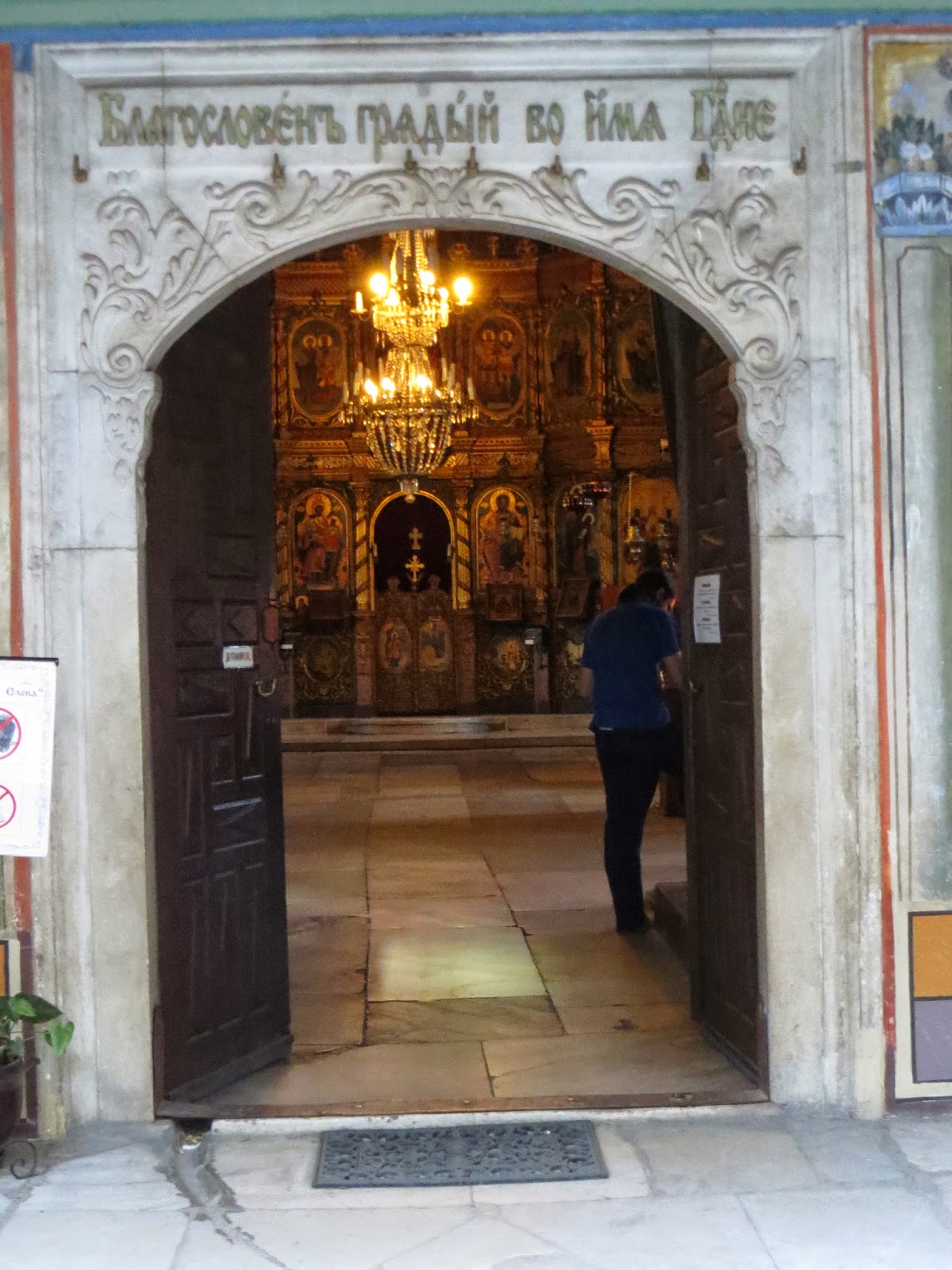
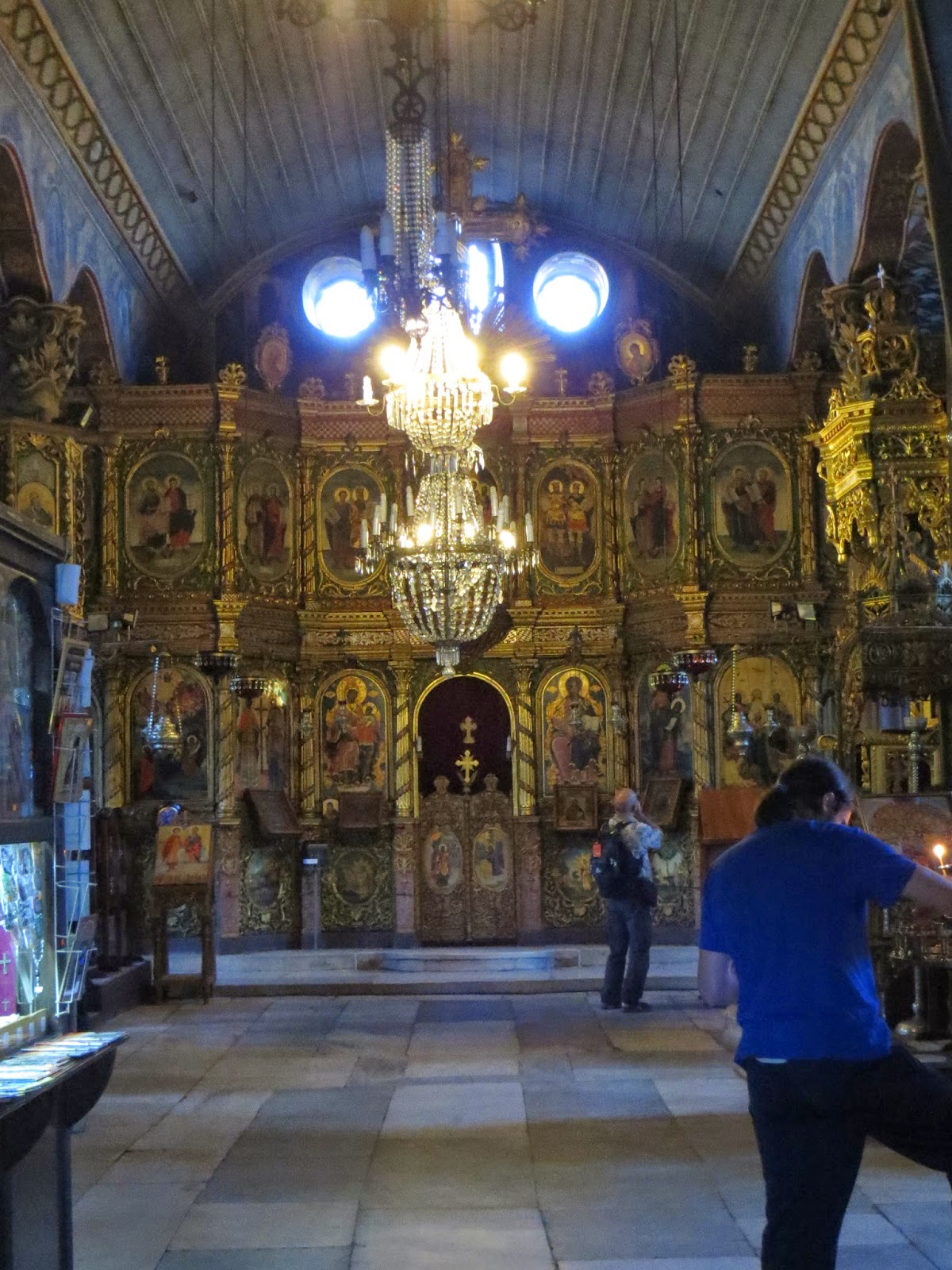
Almost next door to the Cathedral was the Sveti Sveti Konstatin and Elena, an orthodox church constructed in 1832 in a courtyard with a former school, a male convent (another new one for me) and another bell tower. We could hear its bells ring from our hotel, just a stone’s throw away.


Many of you have commented on how much we see in a day and I can appreciate your sentiments. I think though I’ve not done an adequate job explaining how often many of the sights we’re seeing are very close to each other so it doesn’t take us long at all to tour each of the ones in the posts. Plovdiv is certainly a prime example of that as we ‘saw’ all of the above sights in only 4 hours or so in an afternoon and that was after taking the bus in from Sofia. I am confident that it wouldn’t have taken so long if I hadn’t slowed us down on the cobblestone streets which I found quite treacherous and a step away from having a sprained if not a broken ankle!


Wednesday, October 1, 2014

Beautiful Boyana & Death by Chocolate

Sophia is a perfect jumping off spot for anyone one interested in seeing the huge number of monasteries nestled in the mountains surrounding the city but only if you have a car at your disposal. We didn’t so made our way via tram and bus to the southern suburb of Boyana, once a  favorite retreat for communist leaders and now home to Sofia’s wealthy elite, to see two of the city’s major attractions, the 13th C. Boyana Church and the  nearby National Historical Museum before heading to another monastery.
Steven pointing out that the Cyrillic writing indicated  the #64 bus would take us to Boyana Church!
The Boyana Church of St. Nikola and St. Pantaleimon, listed on UNESCO’s World Cultural Heritage list as a ‘must see’, traces its construction back to the 11th C. and is famous for its 90 murals of 1259 that are said to be several decades ahead of the Italian Renaissance. Our wonderful guide described with great animation how the faces and eyes in the royal court tempera paintings, not frescoes, were painted with great attention to detail in the garments and gestures typical of those times in this part of Europe. In the exquisite three dimensional representations of the saints, we could feel them follow us with their eyes wherever we walked in the tiny interior. There were 2 layers of paintings: the first from the 11th and 12th centuries and the next from 1251. The life of Jesus was divided and depicted into both the dramatic and brighter sides of His life. The inscriptions are in Old and Middle colloquial Bulgarian, our guide explained. 


 A maximum of 8 visitors at a time can see the tiny church for a 10 minute guided tour. The church receives 50,000 visitors a year so we were lucky we didn’t arrive later in the day and had to wait for a long time to see it. It is truly miraculous that the church survived earthquakes and wars with the Turks unlike so many other area churches and monuments. It’s believed that even foreign invaders considered it to be a sacred place and therefore not to be attacked.
This was what caught my eye as we entered this part of the church before I was told once again no photos. The stupefying paintings were through a door behind the archway above.
I bought a painting from the artist above. Just need to figure out where to find space to hang it.
We then walked 2kms to the Museum of National History which is housed in the former communist presidential palace and contains Thracian gold treasures, Roman statuary, folk costumes, weaponry and icons. It was interesting to trace the development of social, cultural and political life of Bulgaria through some of its 22,000 exhibits.

Lining both sides of the walkway to the museum's entrance were artifacts to whet our appetites of what was in store for us inside. This one was a fragment of a sarcophagus from the 2nd-3rd C. AD.
There was even this Russian MiG fighter just outside the front entrance, Zachary! No idea what it was doing there though.
What a beautiful entrance and view beyond it of the mountains.


What positively stunning views of the mountains encircling Sophia from the museum. To see it on a sunny day made it even more fantastic after having had 2 days of rain and/or chilly weather.


Funeral offerings from the 7th-6th centuries BC.
As you might imagine, it was quite strange coming across information about Antarctica in a corner of Bulgaria's National History Museum. Turns out that the country has a large contingent of scientists working there. As a result, they have even built an Orthodox Chapel to St. John of Rila there. Amy: I wonder if your husband has seen it while working there now?


A no longer used customs barrier once Bulgaria was admitted to the EU on 1/1/07.


This 'Tree of Life' was a gift to the Bulgarian President from the Jewish community in DC as a mark of gratitude for the rescue of the Bulgarian Jews during WWII. From what we've read, Bulgaria's Jews were saved from the fate suffered by Europe's Jews elsewhere because of the heroic efforts of 2 Orthodox priests. To me, it begs the question why other clerics of all faiths did not stand up more against  Hitler and his fellow Nazi thugs.

With a combination of Steven’s great map reading skills and my asking locals for assistance, we got on the right city bus toward
Dragalevtsi Monastery of the Holy Virgin of Vitosha. We didn’t know when we were dropped off that we had about a mile long up a very potholed, twisty, narrow road in the mountains before arriving at the monastery. The hike was definitely worth it however. The monastery was 1st mentioned in the Vitosha Charter of 1371 and today operates as a convent.
Some people took the easy way up - not us though.
A lousy shot of 2 guys taking their mountain bikes on the chairlift - we saw them race down the mountain not long after this while we were still walking up!

Not sure what the building was on the left here right by the entrance.
The monastery's small chapel above and the interior below.


Just outside the entrance above and below. I had seen the nun earlier in the church gift shop. When I say 'gift shop,' I don't mean a big touristy, gaudy place but rather one run by the church selling mostly candles for people to light, plus lots of icons of all shapes, sizes and, of course, prices. I can't remember being in a church this trip that hasn't had a shop like this. Some of the huge churches have more 'stuff' to purchase to support the church and all have donation boxes.
We spent some time sitting in the sun while taking in the beauty surrounding us before making our way back to the hostel via buses, walking and the city’s lovely metro system. We had just missed the train so that's why the station 'so empty!

Photos of Hostel Mostel below: We didn’t stay in the hostel proper but in an apartment a 5 minute walk away. It was huge even with their being fellow guests in the other rooms but only one shower to share. The signs said No Smoking but all the guests smoked, making it impossible to use the common area at nighttime.  The room rate included a vegetarian dinner and a lovely breakfast of cold meats, cheeses, scrambled eggs and fruit galore – but who would want all that healthy food if you can just feast on hot waffles dripping with this to-die-for chocolate you just spoon out of a jar on each table? I felt like I was a child again and loved every moment of it. You can see how I was once 50 pounds heavier!


Our very large room but it had only one dim overhead light and a negligible light on one side of the bed only. We needed flashlights in the room. Also had to scrounge around for a space heater as the government, who owns the building, hadn't yet turned on the heat and it was SO cold in the apartment. VERY limited lighting too in the common area as befitting a building from the Communist era.
The hostel itself
Todd, one of the very friendly and helpful receptionists; he spoke perfect idiomatic English even though he had never stepped foot in an English speaking country.
Death by chocolate!

My fellow chocoholic.

Goodbye from Sophia!


There was even this Russian MiG fighter just outside the front entrance!

With a combination of Steven’s great map reading skills and my asking locals for assistance, we got on the right city bus toward Dragalevtsi Monastery of the Holy Virgin of Vitosha. We didn’t know when we were dropped off that we had about a mile long up a very potholed, twisty, narrow road in the mountains before arriving at the monastery. The hike was definitely worth it however. The monastery was 1st mentioned in the Vitosha Charter of 1371 and today operates as a convent.


We spent some time sitting in the sun while taking in the beauty surrounding us before making our way back to the hostel via buses, walking and the city’s lovely metro system.